One of the most spectacular fires in the town’s history was the result of a violent lightning and thunderstorm on Thursday, July 11, 1911. At 7:25 P.M., the department responded on a still alarm to Cutler Brothers business block at Main and Water Streets. This large three-story frame building was well involved with fire and at 7:30 P.M., box 35 was transmitted. At 7:40 P.M., a second alarm was requested with assistance rendered from neighboring communities.
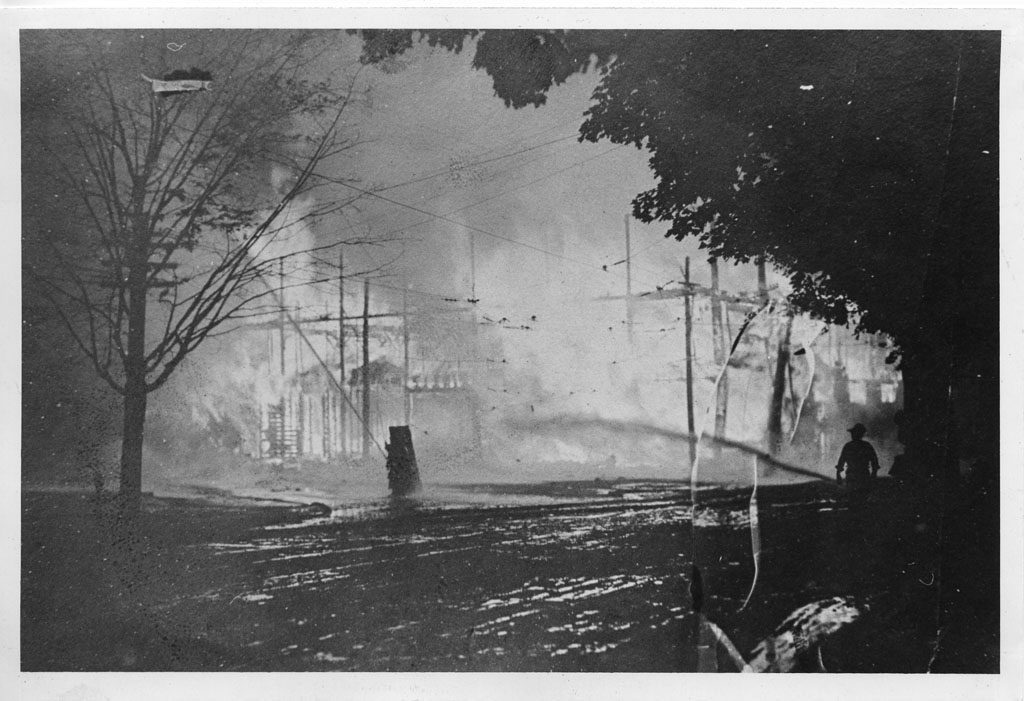
Cutler Building Fire
The tremendous amount of radiated heat caused heavy structural damage to the 2½ story Armory on the south side of the fire building, moderate damage to the Evans Shoe Factory to the rear, and the Town Hall across Water Street, minor damage to the Miller Piano Factory to the rear of Town Hall. A loss of $60,667 was estimated for this fire.
At a cost of $5,800, the town purchased a 1912 Webb, 550 8pm motor-driven pumper that became Engine 1, replacing the 1907 Amoskeag Steamer. This pumper, built in St. Louis, Mo., carried a 40-gallon chemical tank and 1000 feet of hose and was placed in service on October 31, 1912. It was the first motor-driven pumper at the Central Fire Station. The Amoskeag horse-drawn steamer was put in reserve and stored in the basement of the Central Station.
At this same time, the 1906 American LaFrance horse-drawn combination chemical and hose wagon was repainted and reassigned to Greenwood Hose 3.
Until the year 1912, the Chief Engineer’s rank was that of a call position. Now, the rank of Chief Engineer on the three-man Board of Engineers became that of a permanent position. Chief Engineer William E. Cade was appointed to that full-time position with tenure of office.
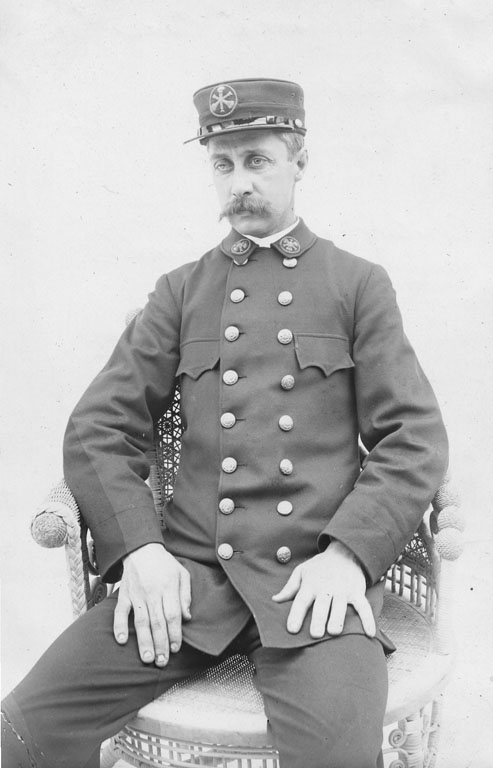
Chief William E. Cade
In 1913, the town voted to spend $350 to build a steel fire observation tower on Hart’s Hill. In service May 18, the forest fire tower is 40 feet high with a 8 foot high frame enclosure on top.
Chief Cade, through the Town of Wakefield, purchased three pieces of motor driven fire apparatus in 1914 at a total cost of $7392.69. These new pieces of apparatus were purchased form the Peerless Motor Co., Cleveland, Ohio, and were delivered in September of 1914. The first of the new apparatus to arrive was the Peerless city-service type ladder truck that was placed in service as Ladder 1 on September 14. It replaced the 1892 Abbot-Downing horse-drawn ladder truck, which was discarded. On September 18, the Peerless chemical and hose wagon was placed in service as Hose 3 at the Greenwood Fire Station, replacing the 1906 American LaFrance horse-drawn wagon. The two 30-gallon chemical tanks were removed from the 1906 wagon and one installed on the ladder truck and one installed on Hose 3.
Finally, a Peerless 6-cylinder squad wagon was put in service on September 22 at the Central Fire Station. This new squad had a long seat running the length of the hose body to carry a number of men when responding to alarms. It also had a hitch that could tow the Amoskeag Steamer if necessary.
With all motor-driven apparatus in service in 1914 except for that of Montrose Hose 4, it was no longer necessary to have horses. The Department’s horses were transferred, two the Municipal Light Department, and four to the Highway Department. The horse stalls at the back of the apparatus floor were removed, creating much needed space to house, in part, the fire alarm equipment that was relocated from the Municipal Gas and Light Plant.
The first Fire Chief’s car was a second-hand Buick Coupe, a 1914 donation by Assistant Engineer Henry Feindel.