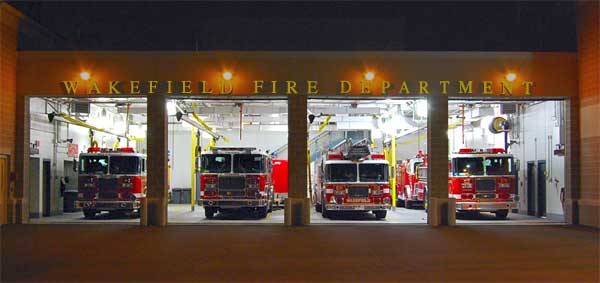
The Wakefield Fireman’s Relief Association was organized on January 15, 1895, and is still active in 1993 (still active as of 2025).
A new Abbot-Downing hose wagon was purchased in 1896 for C. Wakefield Chemical No. 2 in Montrose. This volunteer company was renamed Montrose Hose Company No. 4 in 1897 and remained independent of the Fire Department.
On January 19, 1897, a call was received for a chimney fire on Albion Street at Lake Street. At the time of this alarm, there were no horses available to pull the steamer to the fire. An attempt was made to pull the steamer by hand, proceeding only as far as Main & Albion Streets. This caused the town to consider purchasing horses for the Fire Department.
The town purchased three horses at a cost of $450 in May, 1898, and the rear of the Central Fire Station was remodeled at a cost of $1,200 to accommodate the horses. The first permanent firefighter, William H. Tyzzer, was appointed on May 28th of that year to take care of the horses. Until this date, the entire Fire Department was all call and volunteer personnel.
William E. Cade became Chief Engineer on May 3, 1899, replacing Levi Flanders. At 2:46 A.M. on May 4th, a serious and suspicious fire occurred, completely destroying the Fire Station of Montrose Hose 4 on Salem Street opposite Lowell Street. The fire consumed the 1896 Abbot-Downing horse-drawn hose wagon and all of its equipment, including the old chemical engine. The total loss was estimated at $2,400. The Fire Department loaned Montrose Hose 4 a four-wheel hand-drawn hose carriage that was stored in Gould’s shed on Lowell Street near Salem Street.
In the early hours of Monday, October 23, 1899, the first conflagration in the town’s history occurred. It was a cool, clear night, with a light breeze blowing from the southwest. Police Officer McFadden discovered a fire in Hathaway’s Stable on Mechanic Street and called to Officer Poland to pull fire alarm Box 35, located on the Kingman Building at Main and Albion Streets. Box 35 registered at the Central Fire Station at 1:44 A.M.

Hathaway Fire.
The fire gained such headway that in a matter of minutes the stable was fully involved. As a result, the fire alarm wires were burned and the system rendered useless.
The three story, 50′ X 90′, frame stable was located on the south side of Mechanic Street, about halfway between Main and Crescent Streets. The basement and fire floor were used for the storage of wagons and carriages, the second floor was used as a stable for horses, and the third floor was used for the storage of hay and grain.
After the destruction of the stable, including thirty-nine horses, the fire consumed a total of 18 buildings on Mechanic Street, Crescent Street and Lincoln Street. Along with the houses, stables, sheds and shops destroyed, the fire also consumed the Central Fire Station, which had been moved and remodeled into a fire station at the corner of Crescent and Mechanic Streets in 1891. Among the losses were the fire alarm system, the 1852 Jeffers hand tub of the former Yale No. 1, stored in the basement, and the 1895 supply wagon.
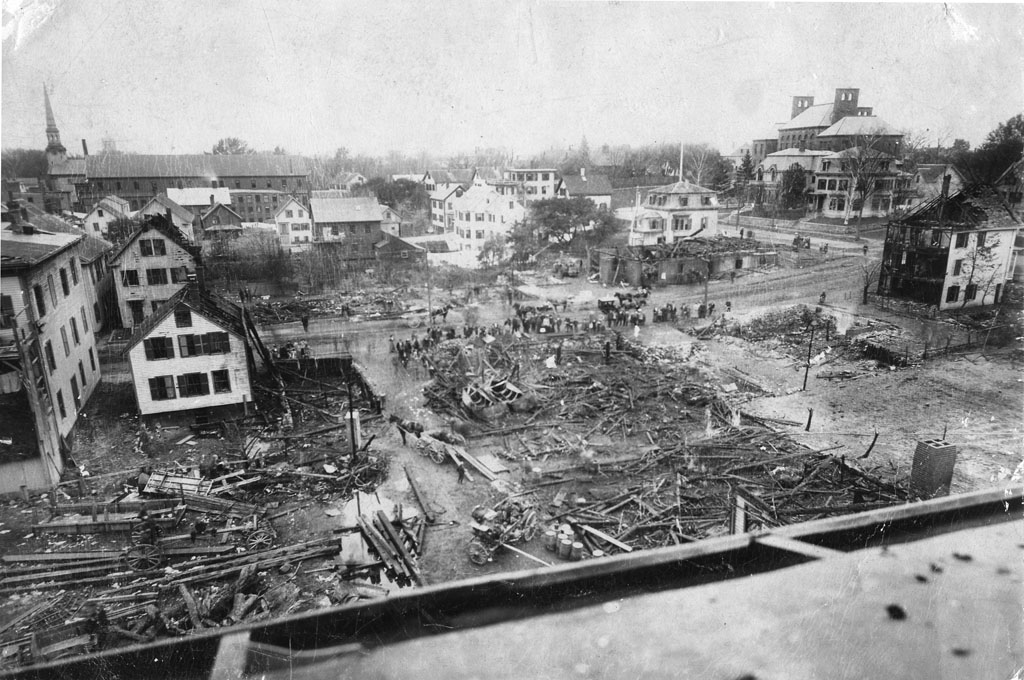
Hathaway Stable Fire
Assistance was received from Reading with their steamer operating at Main and Center Streets. Stoneham had their steamer at Albion and Main Streets. Melrose had a steamer on Main Street just north of Lincoln Street and Malden operated their steamer at Main and Water Streets. Wakefield’s Silsby Steamer was pumping at the corner of Crescent and Lincoln Streets.
With the assistance of various fire alarm Superintendents, and the loan of spare parts from surrounding communities, the fire alarm system was restored to service on the second floor of the Wakefield Block (Main & Mechanic Streets) within 24 hours after the fire was extinguished.