History records Edward H. Walton as Chief Engineer in 1859, 1864, and 1866 through 1868. Charles H. Davis was Chief Engineer in 1860 and 1861; Horatio Dolliver served in the position in 1862 and 1863; Cyrus N. White, in 1865.
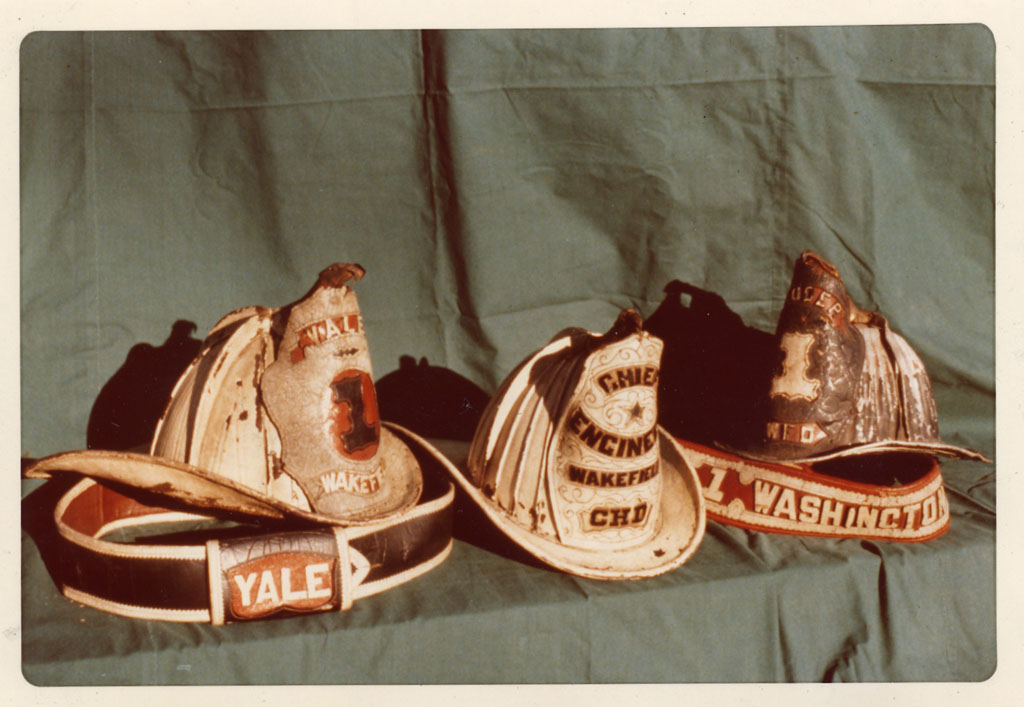
Hemlmets and Belts
In July of 1863, sixteen icehouses on the east shore of Lake Quannapowitt, at the Reading Town Line, were destroyed by an incendiary fire. Three incendiary fires occurred in October of this same year, two in barns on Elm Street. The third fire, in the West District School House on Prospect Street (now known as the West Ward School), was extinguished before much damage was done.
The town officially took the name Wakefield on Wednesday, July 1, 1868. Samuel F. Littlefield became the first Chief Engineer of the three-man Board of Engineers in the Town of Wakefield Fire Department. At this time, the department consisted of one engine, the Yale No. 1, with a two-wheel hose reel and a four-wheel hose reel, all hand drawn, with a total of 1000 feet of 2½ inch leather hose. During the year 1868, there were a total of three alarms of fire. (At this time, this was considered fairly busy.)
In 1870, Frank R. Peacock was elected Chief Engineer, through 1871. In 1871, Wakefield obtained its first ladder company. With the ladders already purchased, a four-wheel hand-drawn carriage was purchased at a cost of $947.50, and placed in service as the Washington Hook and Ladder Company No. 1. This ladder company was housed in the same basement area of the Town House on Church Street, as was the old Black Hawk hand tub engine.
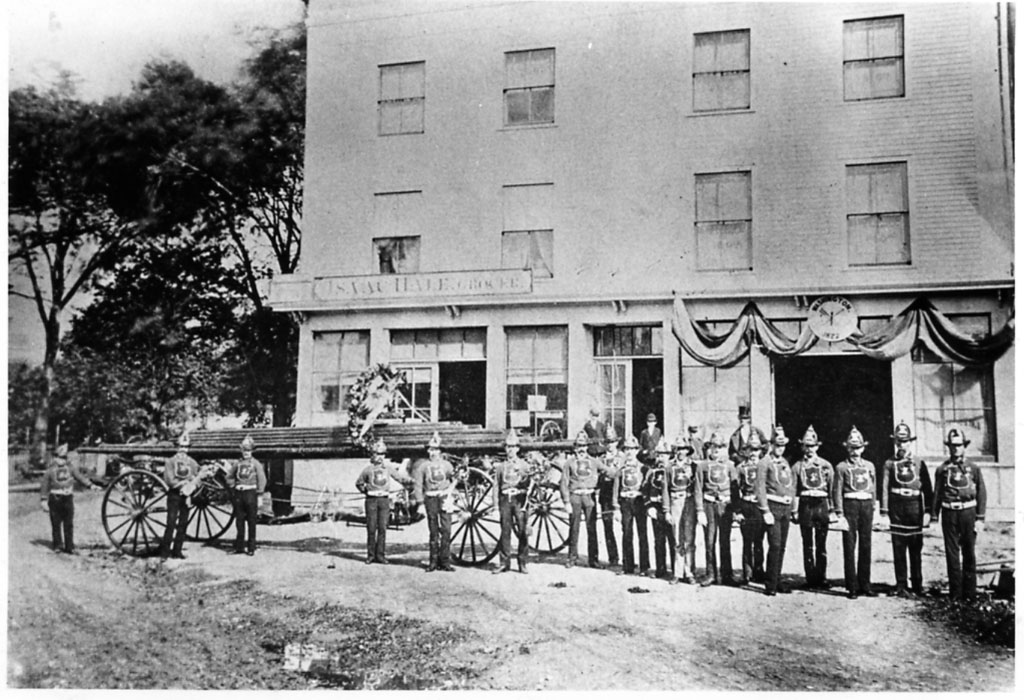
Washington Hook and Ladder
The East Ward residents of the Montrose section, ever aware of the danger of fire, purchased a hand tub engine in 1871 at a cost of $300. This hand tub, reportedly built by Howard E. Davis for Charlestown, Mass. in 1850, was rebuilt by Hunneman Company and named the “C. Wakefield No. 2” when it was put in service in the Montrose Section on October 9, 1871. A new frame 2½ story fire station, on the south side of Salem Street, opposite Lowell Street (called Reid’s Corner) was built for the C. Wakefield No. 2 at a cost of $2,000.
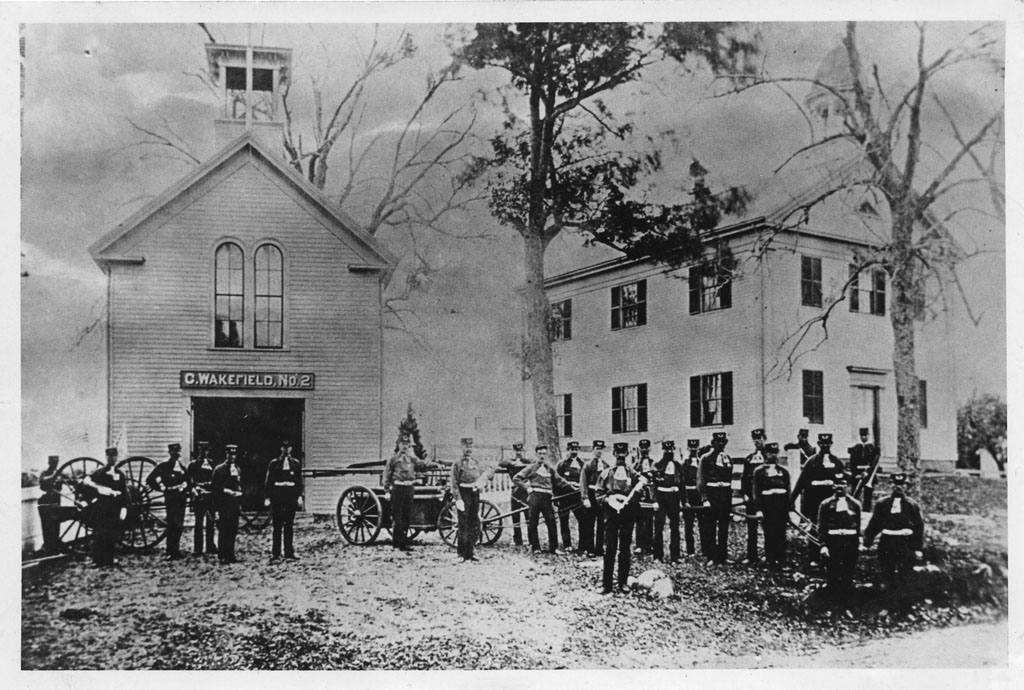
C. Wakefield No. 2
In 1871, a hand-drawn two-wheel carriage, carrying two 35-gallon chemical tanks with 100 feet of 1-inch hose, was purchased from the New England Fire Extinguisher Company at a cost of $800, and placed in service as Chemical Engine No. 1 of the Wakefield Fire Department. It was housed in a small shed next to Jenkins store on the east side of Main Street, opposite Avon Street.
The Yale No. 1 and the C. Wakefield No. 2 left Wakefield on the evening of Saturday, November 9, 1872, upon seeing the glow of the Great Boston Fire. Both companies pulled their engines by hand the entire distance of ten miles in two hours and twenty minutes.
Some Charlestown residents, recognizing their former hand tub, assisted the Wakefield fire fighters, who had reported for duty to Chief Engineer John S. Damrell. Assigned a position on Pearl Street, they directed their first stream of water on the building of Thomas Emerson and Sons. It was only several hours later that firefighters were told that Emerson’s building was owned by Wakefield residents.
The companies remained pumping at the scene until 2 P.M. on Sunday, November 10, when they were relieved by steamer companies, which were part of the aid responding to Boston.
When the old Town House was moved to Main Street, at the southeast corner of Salem Street, in 1873, it was remodeled and raised to create a three-story building. Quarters were provided for the Washington Hook & Ladder Co. and Chemical Engine No. 1 on the first floor. The Paul Revere bell remained in the cupola to sound fire alarms.