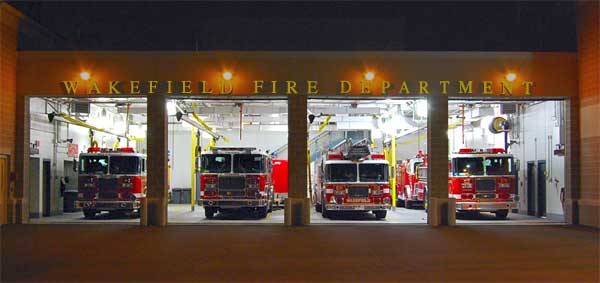
The most serious fire to occur in recent years, perhaps in the town’s history, took place on Saturday, February 5, 1972, at the R.S. Robie Industrial Par, 134 Water Street, opposite Cyrus Street. This large 10-acre industrial complex dates back to 1856 when it was built for the rattan business operated by Cyrus Wakefield. By the 1920’s, it was completely occupied by the Heywood-Wakefield Furniture Company. It consisted of many large frame and brick buildings constructed over the years, some being destroyed by the fire of 1881, and other fires of a lesser degree.
Many of the remaining old frame buildings were replaced years ago by the large brick buildings that existed prior to the fire. These buildings were anywhere from one to four stories in height and measured approximately 80′ x 240.’ Complete sprinkler protection had been installed many years before, supplied by town water, most recently from a 16-inch water main that provided an adequate supply of water for sprinkler protection.
The evening of the fire was clear and cold with gusts of wind reportedly up to 50 mph, creating a chill factor of as much as -38 degrees. A water flow alarm was received at 7:18 from box 31, located on Building No. 2 in the Industrial Park. When first alarm apparatus arrived, heavy smoke was showing in Building No. 2. In a matter of minutes, with fire punctuated by explosions involving the entire three floors of Building No. 2, Captain Jacobs requested the second and third alarms.
When radiated heat rapidly involved exposing buildings of 3 and 4 stories, overpowering the sprinkler systems, Chief Maloney requested many engine and ladder companies after the third alarm. A total of ____pieces of apparatus from ____ communities, along with the Hanscom Air Force Base, responded to the fire.
Before the fire was contained, at about 10:30 P.M., seven large buildings were destroyed and several were damaged. A total of 34 engine companies, 7 aerial ladders, 2 snorkels and one tower ladder were at the fire, operating nine ladder pipes or elevated streams, seven deluge guns and many hand lines. Hydrants were used from the nearby 16-inch water main and from 12 and 20-inch water mains at a distance of 1200 feet from the fire, utilizing relay pumping, with Chelsea Engine 4 using several hundred feet of 4 inch hose. It was estimated that water at a rate of 9650 8pm was in use at the height of the fire.
Some minor fire damage to apparatus was reported. Wakefield Engine 1 was partially burned on the left side of the pumper. Melrose Ladder 1 received a cracked windshield and some dome lights and lenses were melted on Boston Engine 32, Woburn Snorkel and other apparatus.
At approximately 1:00 A.M., February 6, some of the mutual aid and special called apparatus began the difficult task of removing their equipment from the ice and slush on the ground and also remove the ice that coated the apparatus. This took as long as two hours. As the fire was considered under control, fire fighting and overhauling operations continued for the remainder of that night and the next day.
Due to the destruction and the severe cold weather, over-hauling was difficult and dangerous. Weakened walls coated with heavy ice made it necessary for the detail fire companies to work with heavy streams at a safe distance.
Apparatus remained on the scene for three days until Tuesday, February 8. Within a few days, when conditions permitted, enough debris was removed from Building No. 2 to expose the sprinkler alarm valve showing the sprinkler control OS&Y valve in a closed position. It is assumed that radiated heat in an exposed building operated the water flow signal that transmitted the alarm from master box 31.
There was an interesting sidelight regarding the mutual aid response. It was in 1872 that Wakefield responded to Boston for the first time in history. It was in 1972 when Boston returned the mutual aid for the first time.