by L. Murray Young
The history of fire protection dates back to the late 1600’s, when the town was still known as Reading. Townspeople were required to have leather buckets in which water was carried from a brook, pond or well and then passed on in “bucket brigade” style to the scene of a fire. After the water was thrown on the fire, the empty bucket was passed back, often by a line of women and children, to the water source.
The first fire apparatus in the vicinity was obtained in 1805 when the first organized volunteer fire company of Reading secured a four-wheel, hand-drawn tub called the “Republican Extinguisher.” This apparatus had a fixed, long copper gooseneck playpipe that was aimed at the fire from the closest range possible. The “Republican Extinguisher” was housed in a small frame structure on Church Street, west of the Burying Ground site, and remained in service until 1830, when it was apparently discarded in favor of a new piece of apparatus.
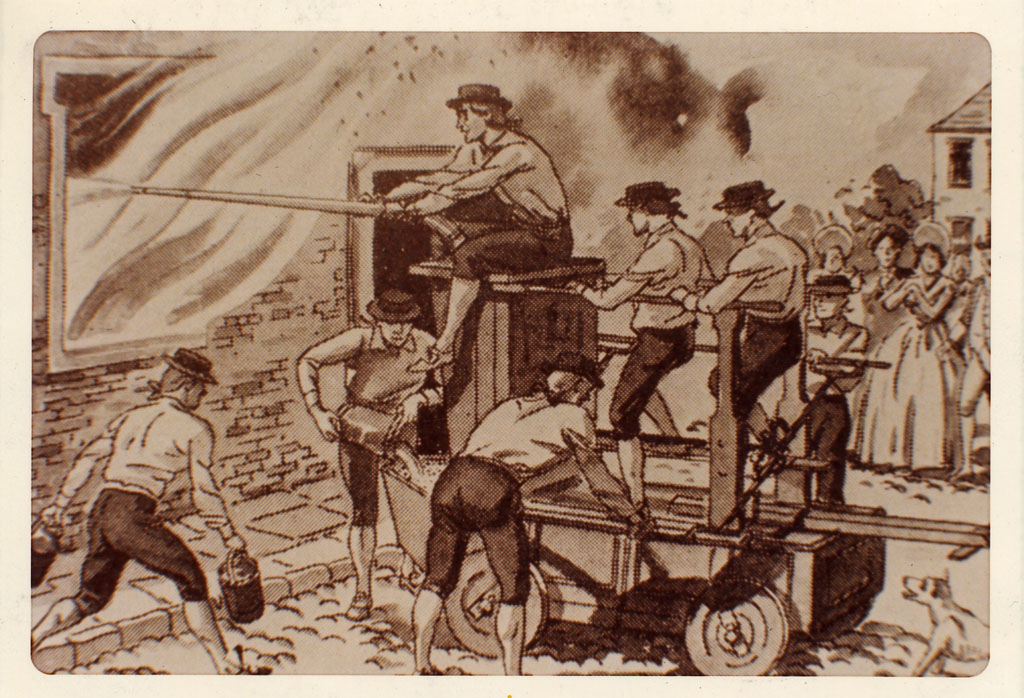
Republican Extinguisher
The “Black Hawk” was larger than its predecessor and was also a four-wheel hand-drawn tub. It contained a lead-in hose from the tank, which was filled by the use of the leather buckets, since it did not have a suction hose. The hose eliminated placing the hand tub as close as possible to the fire. All hose at this time was made from leather, with copper riveted seams. Occasionally, warm grease was pumped through the hose to seal any leaks. The “Black hawk” hand tub was housed in the old “Republican Extinguisher” structure until space was provided in the basement of the new Town House in 1834.
In 1852, a committee was formed to purchase a new hand-tub; in February 1853, a William Jeffers hand tub was purchased. This Jeffers hand-tub was named after one of South Reading’s most prominent citizens, Burrage Yale, Esq., and was known as Yale No. 1. The Yale No. 1 had a rosewood finish body and a suction hose for drafting water from a well or other water source. A separate two-wheel hose reel was also purchased to carry the 2½ inch leather hose. The Yale was capable of pumping two hose lines by pumping the brakes in the same manner as the two preceding hand-tubs.
The first fire station in the town’s history was a wood frame two-story engine house, built in 1852 at a cost of $970. This station, located to the right of the Town House on Church Street, just west of Main Street, was known as the Yale No. 1 station, housing the Yale No. 1 hand-tub and its two wheel hose reel.
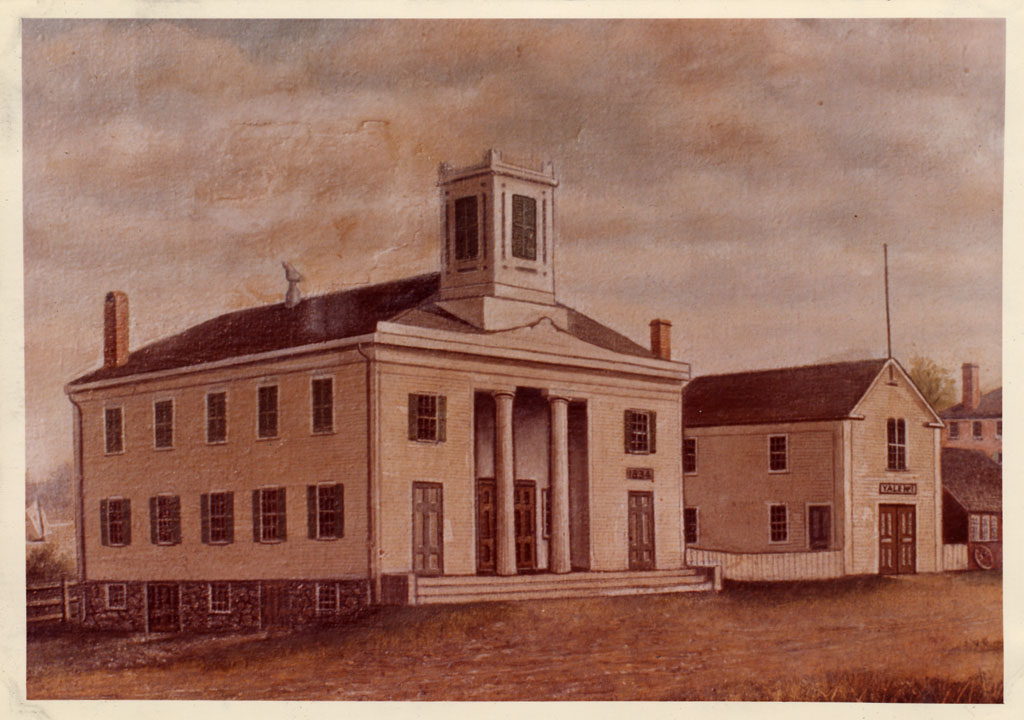
First Fire Station (right of Town House)
It was in 1854 that an Act to establish a Fire Department in the town of South Reading was enacted by the Senate and the House of Representatives in the General Court. This Act to regulate Fire Departments was passed on Monday, April 9, 1854, and approved by the Governor four days later.
The Board of Selectmen appointed Ira Wiley the first Chief Engineer of the Board of Engineers established to carry out the duties of the Act to regulate Fire Departments (Until the Act was approved, fire companies had been headed by foremen).
Any building is subject to destruction by fire, and that includes fire stations. The first of three fire station fires in the town’s history occurred at 3:30 A.M. on Friday, September 30, 1859, when fire destroyed the two-story frame Yale No. 1 Station. The fire was discovered by Mrs. Flanders on Spaulding Street, whose husband managed to save the Yale hand tub. The two-wheel hose reel, however, was consumed.
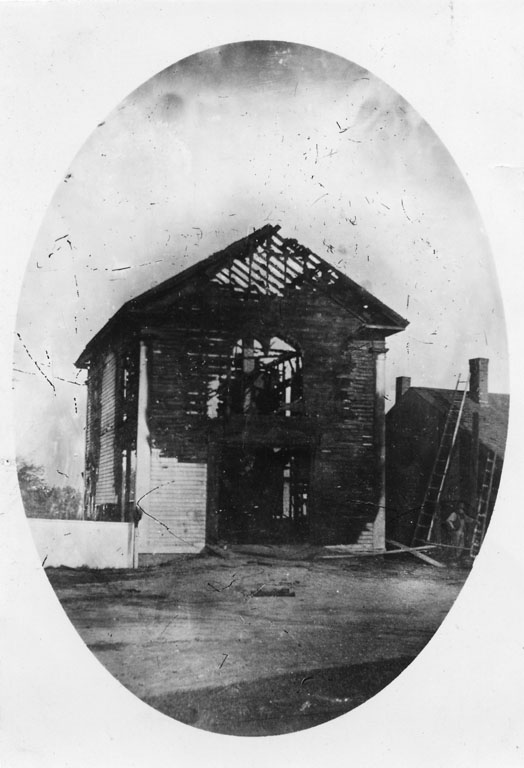
Burnt Yale No. 1
Immediately thereafter, preparations were made to construct a new fire station on the same site. A 2½ story, brick-veneer building was erected at a cost of $2064.49, and the Yale was back in service in the new Church Street station before the end of 1859. A new two-wheel hose reel was purchased in 1859.
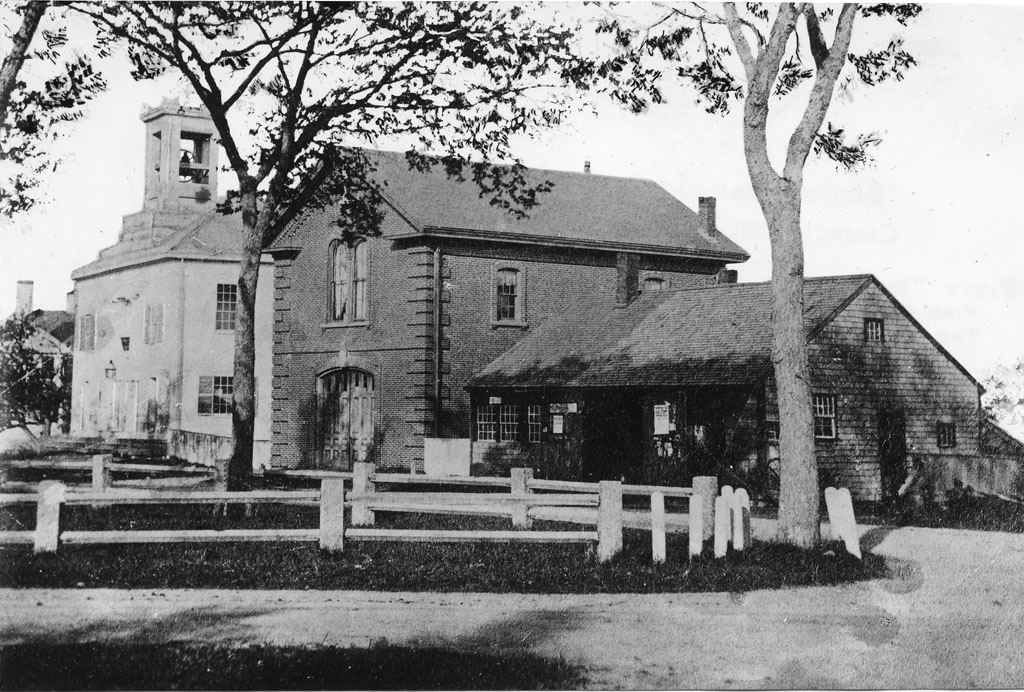
Brick Yale No. 1 flanked by the Town House and blacksmith shop
The Paul Revere bell, cast in 1815 and originally hung in the Congregational Church tower as a town bell, was also used for fire alarm signals. This bell was moved to the cupola of the Town House in 1859.